Third album of the Jon Hassell Pentimento Trilogy is announced
The new album captures Jon Hassell performing as part of a trio with Rick Cox and John von Seggern at St John at Hackney church, London on 23 May 2015, carefully edited and mixed by Jeff Rona into something that is much more than a traditional ‘live album’. Themes, motifs and riffs from Hassell’s two final albums, Listening To Pictures and Seeing Through Sound, occur throughout these unique, semi-improvised mutations, making this a fitting final volume in the late career renaissance of the Pentimento series. It contains a liner note essay by Jon Hassell that inspired the title, and is also available as part of The Pentimento Trilogy boxset.
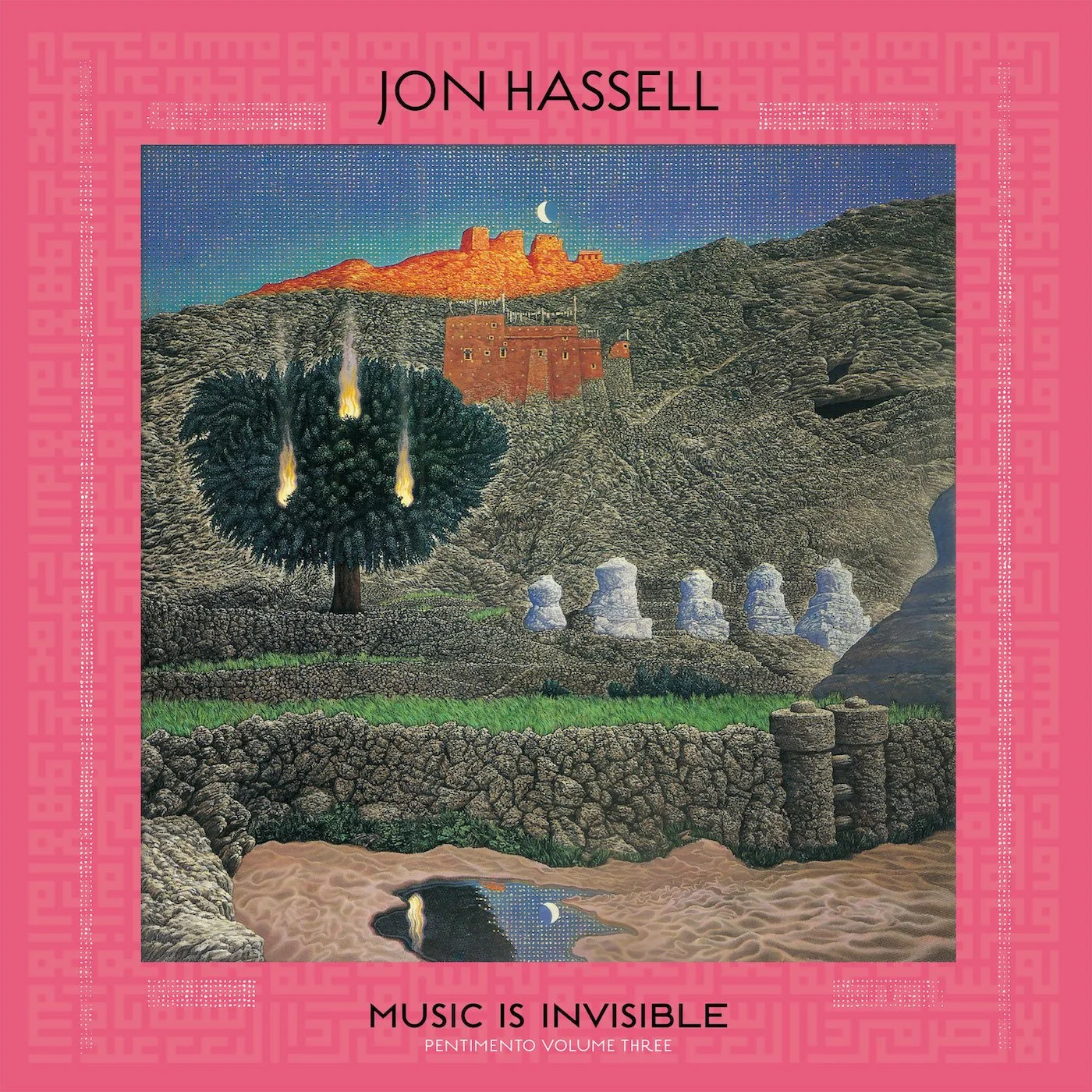
Before Jon Hassell passed away in June 2021, he released two remarkable and critically adored albums: Listening To Pictures (2018) and Seeing Through Sound (2020), presented as parts one and two of the Pentimento series. ‘Pentimento’ is defined as “the appearance in a painting of earlier images, forms, or strokes that have been changed and painted over”, a methodology that Jon applied in a musical sense throughout his career, refining and developing his approach over time.
Specifically, Hassell would take previous recordings, whether captured audio from a concert he had performed, or snippets of rehearsals, and use it as base material to play fresh parts over, or take certain sections and loop them into a whole new piece, echoing the ‘version’ approach of dub reggae music from Jamaica, filtered through his love of Teo Macero’s radical tape cut-ups of Miles Davis in the 1970s. Examples of this can be seen as early as 1980’s Brian Eno-produced Fourth World Vol. 1 - Possible Musics where material taken from previous album Earthquake Island, and a live concert recording from the Art Gallery Of Ontario, serve as the launchpad for the musicians to play over as a sound bed, and make entirely new pieces out of the resulting parts. This continues right up to final studio album Seeing Through Sound, where recordings of Jon and band in a church in Vienna, or laying down a session for Radio France are edited, overdubbed, or even overlaid with a completely different recording to create a kind of sonic collage.
All of this is to say that whilst Music Is Invisible does capture Jon Hassell and band performing live, the blurred lines between ‘studio’ and ‘live’ in the Hassell discography means that the category distinctions become somewhat meaningless. The musicians here are playing using a sound bed of samples taken from different sources (often their own previous performances), combined with the extensive editing, clean-up work and subtle sampling employed at the mixing and post-production stage, means this is as much a ‘studio’ record as many other entries in the artist’s body of work. The other two ostensibly ‘live’ albums in the rich Hassell discography, The Surgeon Of The Nightsky Restores Dead Things By The Power Of Sound (1987) and The Living City (issued 2023, recorded in 1989). were also created using this sensibility.